
Sex, identity and hermaphroditism in Iberia, 1500-1800 (autor junto a Richard Cleminson)
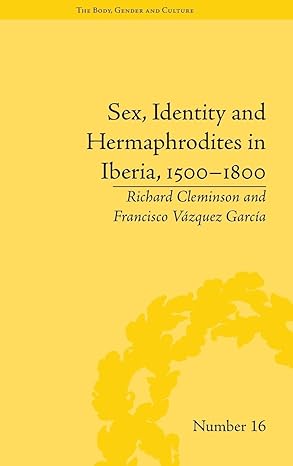
Referencia completa: Cleminson, Richard y Vázquez García, Francisco: Sex, identity and hermaphroditism in Iberia, 1500-1800, London, Pickering and Chatto, 2013
This book builds on the established research of the co-authors on the history of sexuality in Spain and moves our interest in new chronological and thematic directions. While our previous work has examined the history of male homosexuality and hermaphroditism primarily in the nineteenth and twentieth century, this study seeks to examine the legal, medical, philosophical and religious meanings and interpretations given to individuals deemed to be ‘in between’ the sexes in earlier centuries. In the nineteenth and twentieth centuries, new diagnostic frameworks guided by different social, political and medical realities replaced older models on the understandings of ‘ambiguous’ individuals and what these individuals signified for a particular society at the time. Up to the late 1700s, such individuals were viewed through a prism that was refracted by thought deriving from Aristotelian, Hippocratic and other ancient Greek, Islamic and European religious and medical thought that placed ‘hermaphrodites’ within the realm of the supernatural, monstrous or as portents of substantial changes in society. Hermaphrodites, in this sense, were eminently possible and were viewed as ‘natural’ phenomena within a diverse order governed by God.
In much of Europe during the early part of the period covered in this book, it has been argued that there prevailed a ‘one-sex’ model by which human beings were thought to be essentially the same in body and mind, although males would possess genitalia external to the body and females would possess internal genitalia. Hermaphrodites were seen as a variation between full maleness and full femaleness and not necessarily a pathological form. From the early seventeenth century, it has been argued by numerous historians, medical and legal thought underwent a substantial transformation in terms of the understanding of the relationship between maleness and femaleness with an increasing appreciation that the two forms were in fact significantly differentiated. This period has been labelled as passing towards a ‘two-sex’ model whereby men and women were perceived by doctors and society at large as fundamentally and incommensurably different. As a concomitant change, it was thought that true hermaphrodites were no longer possible in human kind; rather, any ambiguous individual was posited as a ‘pseudo-hermaphrodite’ and the ‘true’ sex of the individual was to be determined by a cohort of specialised medico-legal experts who participated in the construction of the modern, centralised, individualised state. In light of such developments, the old notions of the hermaphrodite as a marvellous or monstrous being faded away, dismissed as a medieval superstition.
El libro puede adquirirse pinchando en este enlace.